RESEARCH / CULTURAL HERITAGE / CONSTITUTIONAL STUDY
“We are not asking Ireland to accept an unproven legal conclusion. We are asking Ireland to investigate its own indigenous legal continuity and determine what recognition is constitutionally possible.”
A Proposal for Ireland
This is a proposal for investigation, scholarship and democratic discussion.It does not claim that the answers have already been decided.It asks Ireland to investigate its own legal inheritance — carefully, openly and constitutionally — and to determine what, if anything, from that inheritance can responsibly contribute to the future.
Brehon sovereignty begins with knowledge. The future begins with the people.
Get Started, Explore, Contact Us - info@7arcs.irish
A PROPOSAL FOR THE RECOGNITION AND REVITALISATION OF BREHON LAW AND IRISH LEGAL HERITAGE
A respectful proposal to the Government, Oireachtas and people of Ireland
Re: Brehon Law, cultural sovereignty, legal heritage, restorative justice and community autonomy
1. Purpose of this submission
Ireland possesses a distinctive legal heritage that predates the modern State by many centuries.
The body of customary law commonly known as Brehon Law formed an important part of Gaelic Irish society and included principles concerning contracts, property, kinship, compensation, dispute resolution, obligations and relationships between communities.
The purpose of this submission is not to propose the abolition of Irish law, the creation of a rival State, or the displacement of the Constitution.
Rather, we propose that Ireland should examine whether elements of this legal heritage can be preserved, studied, practised and, where appropriate, recognised within the modern constitutional order.
We believe this question deserves an open, evidence-based national discussion.
2. A distinction between historical law and modern legal recognition
We recognise that historical Brehon Law cannot simply be declared to be the presently enforceable law of Ireland.
The modern Irish State operates under the Constitution of Ireland, and Article 6 provides that governmental powers are exercised by or on the authority of the organs of State established by the Constitution.
Accordingly, any modern recognition of Brehon principles must be developed consistently with the Constitution, legislation, fundamental rights and the rule of law.
Our proposal is therefore not:
“Replace Irish law with Brehon Law.”
It is:
“Explore how Ireland can give meaningful modern recognition to its own indigenous legal heritage within the constitutional State.”
3. Brehon Law as living cultural heritage
The fact that a historical legal system is no longer the general law of the State does not mean that its study, preservation or cultural revival should cease.
Brehon Law represents an important part of Ireland's intellectual, cultural and legal history.
Its surviving manuscripts, scholarly editions, archaeological context, linguistic heritage and historical institutions deserve continued research and public engagement.
We therefore propose the establishment of a national programme for:
- Brehon legal scholarship;
- preservation and digitisation of relevant manuscripts;
- public education;
- university research;
- Irish-language legal terminology;
- reconstruction of historical dispute-resolution practices;
- examination of restorative and community-based principles;
- and consideration of which principles could have legitimate modern applications.
4. A modern model of cultural legal autonomy
We invite the State to examine whether a voluntary form of Brehon cultural autonomy could operate within Irish law.
Such a framework could potentially include:
- voluntary mediation;
- restorative-justice practices;
- community dispute resolution;
- cultural and educational institutions;
- arbitration where legally permitted;
- research and teaching in Brehon jurisprudence;
- preservation of customary practices that are compatible with constitutional rights;
- cultural stewardship of archaeological and historical sites;
- community participation in decisions concerning relevant cultural heritage.
Any such institution would remain subject to Irish constitutional law and applicable legislation.
5. Arbitration and alternative dispute resolution
Ireland already possesses a modern legal framework for arbitration.
The Arbitration Act 2010 provides a statutory framework under which arbitral awards may, subject to the Act, be enforceable in the State.
We therefore ask the Government and legal profession to examine whether Brehon-inspired mediation and arbitration institutions could be developed within that existing framework.
This would not require the creation of an independent criminal jurisdiction or competing court system.
Instead, it could provide a lawful mechanism through which individuals who voluntarily participate could explore forms of dispute resolution inspired by historical Irish principles.
The distinction is important:
cultural arbitration is not the same thing as sovereign criminal jurisdiction.
6. A possible Brehon Cultural Council
We propose consideration of an independent Brehon Cultural Council, established through an appropriate legal or institutional mechanism.
Its possible functions could include:
- maintaining a scholarly register of Brehon legal sources;
- advising public bodies on Irish legal heritage;
- supporting academic research;
- developing educational materials;
- supporting Irish-language legal terminology;
- accrediting voluntary cultural mediation programmes;
- developing ethical standards;
- documenting customary practices;
- and advising on the cultural significance of land, monuments and archaeological sites.
Membership should include historians, legal scholars, archaeologists, Irish-language specialists, community representatives and other relevant experts.
7. Land, resources and the public interest
We also propose a serious examination of the historical and constitutional principles governing Ireland's land and natural resources.
Article 10 of the Constitution addresses natural resources, State lands, mines, minerals and waters and provides a constitutional framework for their ownership and management.
The Constitution also recognises principles concerning the common good and the distribution and control of material resources.
We therefore propose a public examination of whether modern resource policy adequately reflects the principle that natural resources should be managed for the long-term benefit of the people of Ireland.
This should be approached as a question of constitutional law, public policy and intergenerational stewardship, rather than as an assumption that historical Brehon ownership automatically determines present-day title.
8. Three possible stages of recognition
We propose that consideration proceed in three stages.
Stage One — Cultural recognition
Establish Brehon Law explicitly as an important component of Ireland's legal and cultural heritage.
Create educational, research and archival programmes.
Stage Two — Voluntary civil and cultural institutions
Examine the establishment of voluntary Brehon-inspired mediation, arbitration, educational and cultural institutions operating entirely within Irish law.
Stage Three — Constitutional consideration
If, following research and public consultation, there is a sufficiently developed case for a distinct form of cultural autonomy, the Government and Oireachtas could consider whether legislation or constitutional amendment would be appropriate.
No constitutional conclusion should be predetermined.
The people of Ireland would retain the constitutional mechanisms through which constitutional change may be considered.
9. What this proposal does not seek
This proposal does not seek:
- the overthrow of the Irish State;
- secession from Ireland;
- the creation of a competing State;
- immunity from Irish criminal law;
- the replacement of the Constitution;
- the displacement of the courts;
- compulsory participation in Brehon institutions;
- or the removal of rights guaranteed by Irish or European law.
The proposal is for recognition, research, cultural revival and lawful institutional development.
10. Request to the Government and Oireachtas
We respectfully request that the Government and Oireachtas consider establishing an independent working group or commission to examine:
- the historical status of Brehon Law;
- the legal history of its suppression and disappearance from the modern Irish legal system;
- the constitutional position of Irish legal heritage;
- the potential for Brehon-inspired mediation and arbitration;
- models of cultural autonomy within democratic constitutional states;
- the protection and stewardship of Irish cultural and natural heritage;
- the compatibility of any proposed institutions with fundamental rights;
- and whether legislation should be introduced to support Brehon cultural and educational institutions.
We further request that the resulting report be published and made available for public consultation.
11. A national conversation
The question before Ireland need not be whether we return to the past.
The more constructive question is whether Ireland can learn from its legal past while building institutions appropriate to the present.
Brehon Law should neither be romanticised nor dismissed.
It should be studied seriously.
Its historical principles should be tested against modern standards of equality, human rights, democracy and constitutional government.
Where useful principles can be identified, Ireland should be free to consider whether they can contribute to modern Irish civic life.
12. Closing statement
Ireland has a constitutional State, a modern legal system and a rich legal history extending far beyond the establishment of the present State.
We believe those facts do not have to be placed in opposition.
The objective should be to build a bridge between them.
Our proposal is therefore simple:
Recognise the history.
Research the law.
Preserve the heritage.
Explore lawful cultural autonomy.
Develop restorative and community-based institutions where appropriate.
And allow the people of Ireland to decide, through the constitutional process, any question requiring constitutional change.
We ask the Government and Oireachtas to begin that process.
Brehon Law need not replace Irish law in order to become part of Ireland's future.
"Explore how Ireland can give meaningful modern recognition to its own indigenous legal heritage within the constitutional State."
Our heritage.
Our responsibility.
Our future.
A Modern Brehon Institution
One possible outcome of such an investigation would be the creation of a cultural institution provisionally called:
The Brehon Council of Ireland
The Council would not initially be a State court.
Its proposed functions could include:
-
research;
-
education;
-
archival preservation;
-
Irish-language legal scholarship;
-
cultural mediation;
-
restorative practice;
-
publication;
-
training;
-
historical interpretation;
-
archaeological collaboration;
-
and development of ethical standards for Brehon-inspired practice.
It could also maintain an open digital archive of historical Brehon legal materials.
The Council's work should be transparent, evidence-based and subject to modern standards of equality and human rights.
Brehon-Inspired Mediation
One of the most practical areas for exploration is mediation.
Historical Irish legal traditions contain concepts involving compensation, obligation, reputation, reconciliation and restoration.
Modern Ireland already provides legal space for consensual dispute resolution.
A Brehon-inspired mediation service could therefore explore voluntary approaches to:
-
community disagreements;
-
neighbourhood disputes;
-
interpersonal conflicts;
-
cultural disputes;
-
reconciliation;
-
restorative practices;
-
and other matters suitable for consensual mediation.
Participation would be voluntary and the service would operate under Irish law.
It would not replace the courts.
Voluntary Arbitration
A second area for investigation is arbitration.
Ireland's Arbitration Act 2010 provides the statutory framework for arbitration. Section 23 provides that an arbitral award made under an arbitration agreement can, subject to the Act, be enforceable in the State, including through the High Court in the circumstances specified by the legislation. Irish Statute Book
The Act incorporates the UNCITRAL Model Law framework, including provisions concerning the conduct of arbitral proceedings and the choice of language. Irish Statute Book
This creates a potential legal space for a Brehon-inspired arbitral institution.
The distinction is essential:
A Brehon-inspired arbitral institution operating under Irish arbitration law is not the same thing as a sovereign Brehon court.
A future institution could potentially allow consenting parties to ask an arbitral tribunal to consider principles inspired by historical Irish jurisprudence, subject always to mandatory Irish law and applicable rights.
Possible principles for study could include:
-
restoration;
-
compensation;
-
good faith;
-
reciprocal obligation;
-
proportionality;
-
community impact;
-
reputation;
-
customary practice;
-
and reconciliation.
The purpose would be to investigate whether historical concepts can contribute constructively to modern dispute resolution.
Criminal Law
Criminal jurisdiction presents a different question.
This proposal does not seek to establish private criminal courts or replace the State's criminal justice system.
Criminal offences would remain matters for the State's legal system.
However, Brehon-inspired institutions could potentially contribute to lawful restorative-justice programmes where authorised by the existing justice system.
Possible areas of contribution could include:
-
victim-offender mediation;
-
community restoration;
-
reconciliation;
-
community-based programmes;
-
cultural education;
-
and other restorative practices permitted by law.
The distinction protects both constitutional government and the credibility of the wider cultural proposal.
Land, Property and Community
Historical Brehon concepts concerning land deserve careful study.
Irish land history encompasses Gaelic customary systems, Norman arrangements, confiscations, plantations, landlordism, land reform and modern registered title.
It would therefore be incorrect to claim that a medieval Brehon principle automatically establishes ownership of land today.
Historical concepts may nevertheless have contemporary cultural relevance.
Research could examine questions of:
-
communal stewardship;
-
common resources;
-
cultural landscapes;
-
environmental responsibility;
-
intergenerational interests;
-
community participation;
-
and relationships between land and community.
The objective would be scholarship and policy development rather than automatic alteration of modern property titles.
Principles for Any Future Institution
Any institution receiving official recognition should operate according to clear principles.
- Democratic accountability
Institutions should be accountable to their members, participants and the wider public.
- Constitutional compatibility
No institution should claim governmental powers unless those powers have been lawfully created.
- Human rights
Modern institutions must respect constitutional and human-rights protections.
- Equality
Historical practices should not be revived simply because they are historical. Contemporary institutions must meet modern standards of equality.
- Voluntary participation
Cultural and mediation institutions should operate through lawful consent unless legislation provides otherwise.
- Transparency
Rules, procedures, governance and funding should be publicly accessible.
- Scholarly integrity
Historical claims should be supported by evidence and open to scholarly examination.
- Cultural continuity
Irish-language knowledge, historical research and cultural transmission should remain central to the project.
Why This Matters
Ireland's legal heritage is broader than the laws inherited from Britain and the institutions established after independence.
The Gaelic legal tradition is part of the historical story of Ireland.
Studying that tradition can contribute to contemporary discussions about:
-
restorative justice;
-
community responsibility;
-
cultural identity;
-
language;
-
land stewardship;
-
environmental responsibility;
-
dispute resolution;
-
heritage protection;
-
and democratic participation.
The purpose is not to romanticise the past.
Nor is it to deny the modern constitutional State.
It is to understand Ireland more completely.
Our Ten Requests
We respectfully call for the Government of Ireland to establish an independent Commission on Brehon Law and Irish Legal Heritage and ask that it:
-
Investigate the historical status and development of Brehon Law.
-
Identify, preserve and publish surviving primary sources.
-
Examine the constitutional questions surrounding Ireland's indigenous legal heritage.
-
Investigate the potential for voluntary Brehon-inspired mediation.
-
Examine the possibility of voluntary arbitration operating within Irish law.
-
Study international examples of customary and Indigenous legal recognition.
-
Consult communities, universities, cultural organisations and Irish-language institutions.
-
Examine historical approaches to land, community and natural-resource stewardship.
-
Make recommendations concerning education, heritage, legislation and public policy.
-
Identify any question that should ultimately be determined by the people through the constitutional process.
What Do We Mean by “Brehon Sovereignty”?
The word sovereignty requires care.
It can describe different things.
Political sovereignty
The sovereignty of the State and the constitutional authority exercised through its institutions.
Ireland is constitutionally described as a sovereign, independent and democratic State. Article 6 provides that governmental powers derive from the people but are exercisable only by or on the authority of the organs of State established by the Constitution. Irish Statute Book
This proposal does not seek to establish a competing State.
Legal jurisdiction
The authority of courts and other legally recognised institutions to determine disputes and exercise legal powers.
A private organisation cannot simply declare itself to possess State judicial jurisdiction.
Cultural sovereignty
The ability of a people and community to preserve, develop and transmit their culture, language, traditions, institutions and heritage.
This is the principal sense in which this proposal uses the term Brehon sovereignty.
The proposal is therefore about cultural self-determination and legal heritage, not a claim that an independent Brehon government currently possesses sovereign authority in Ireland.
Ireland Had a Legal Tradition Before the Modern State
Brehon Law refers broadly to the indigenous legal traditions of Gaelic Ireland, associated with the brithem — the professional legal scholar of the time.
Its surviving sources address contracts, property, kinship, inheritance, compensation, injury, marriage, reputation, community obligations and dispute resolution.
Brehon Law was not a single modern code, but a complex body of custom, legal learning and written commentary developed over centuries.
Its modern study therefore requires historical context and careful scholarship, rather than simply transplanting medieval rules into the present.
Brehon Heritage and the Constitution
Any modern programme must operate within the Constitution of Ireland.
Article 5 establishes Ireland as a sovereign, independent and democratic state.
Article 6 provides that governmental powers derive from the people while requiring those powers to be exercised by or under the authority of the constitutional organs of State.
Article 8 establishes Irish as the national and first official language and recognises English as a second official language.
Article 10 contains specific provisions concerning natural resources, State land, mines, minerals and waters. Irish Statute Book
These provisions provide an important constitutional framework for considering cultural heritage, language, public resources and any future institutional proposals.
They do not, however, establish an existing independent Brehon jurisdiction.
Any new legal powers would have to be created through the constitutional and legislative system.
Natural Resources and Stewardship
Article 10 of the Constitution contains specific provisions concerning natural resources, land, mines, minerals and waters belonging to the State, subject to existing lawful estates and interests. It also provides for legislative management and control of State property. Irish Statute Book
This constitutional framework provides a useful starting point for examining the relationship between public resources and long-term stewardship.
Rather than attributing a modern legal doctrine to Brehon Law without evidence, research should ask a more precise question:
What can the historical Irish understanding of communal responsibility contribute to modern thinking about stewardship?
Possible areas include:
-
protection of natural resources;
-
long-term environmental responsibility;
-
cultural landscapes;
-
archaeological heritage;
-
community participation;
-
and obligations towards future generations.
Brehon Law cannot provide automatic answers to modern environmental questions.
But its historical perspectives may be worth studying.
Three Stages of Brehon Revival
Stage One — Recognition and Research
Establish a national programme dedicated to Brehon legal heritage.
Its objectives could include:
-
collecting historical sources;
-
digitising manuscripts;
-
funding academic research;
-
supporting Irish-language scholarship;
-
establishing university programmes;
-
preserving archaeological and cultural material;
-
and producing a comprehensive national history of Brehon Law.
Proposed outcome
National Brehon Law and Irish Legal Heritage Report
Stage Two — Cultural and Civil Institutions
Following the research stage, establish voluntary institutions capable of developing:
-
cultural mediation;
-
restorative practices;
-
legal education;
-
historical interpretation;
-
arbitration where legally permitted;
-
community programmes;
-
and Irish-language legal scholarship.
Proposed outcome
Brehon Cultural and Restorative Justice Framework
Stage Three — Constitutional and Legislative Review
If the evidence supports further recognition, the Government could consider appropriate legal mechanisms.
These might include:
-
statutory cultural recognition;
-
recognition of particular institutions;
-
legislation establishing defined functions;
-
protected cultural functions;
-
or, if genuinely necessary, constitutional amendment.
Any constitutional amendment would have to follow the constitutional process.
The final question should belong to the people of Ireland where the Constitution requires their approval.
Proposed outcome
A national decision based on evidence, consultation and constitutional procedure.
Sources and Legal Foundation
This proposal should be read alongside the primary legal and parliamentary materials on which its constitutional and historical claims are based.
Constitution of Ireland
The official Irish Statute Book contains the current constitutional text, including Articles 5, 6, 8 and 10. Irish Statute Book
Read the Constitution of Ireland — Irish Statute Book
2007 Statute Law Revision Debates
The Houses of the Oireachtas debates contain the Government's statements concerning the historical status of Brehon Law during the Statute Law Revision process, including the statement that Brehon Law was predominantly oral and had been suppressed over a long historical period. Oireachtas+1
Read the 2007 Oireachtas debate
Arbitration Act 2010
Section 23 establishes the statutory effect and enforceability of qualifying arbitral awards in the State. Irish Statute Book
Read Section 23 of the Arbitration Act 2010
Constitution of the Irish Free State 1922
The 1922 constitutional text provides an important primary source for research into the legal transition following independence, including its treatment of State lands, waters, mines, minerals and natural resources. Irish Statute Book
Read the 1922 Constitution — Irish Statute Book
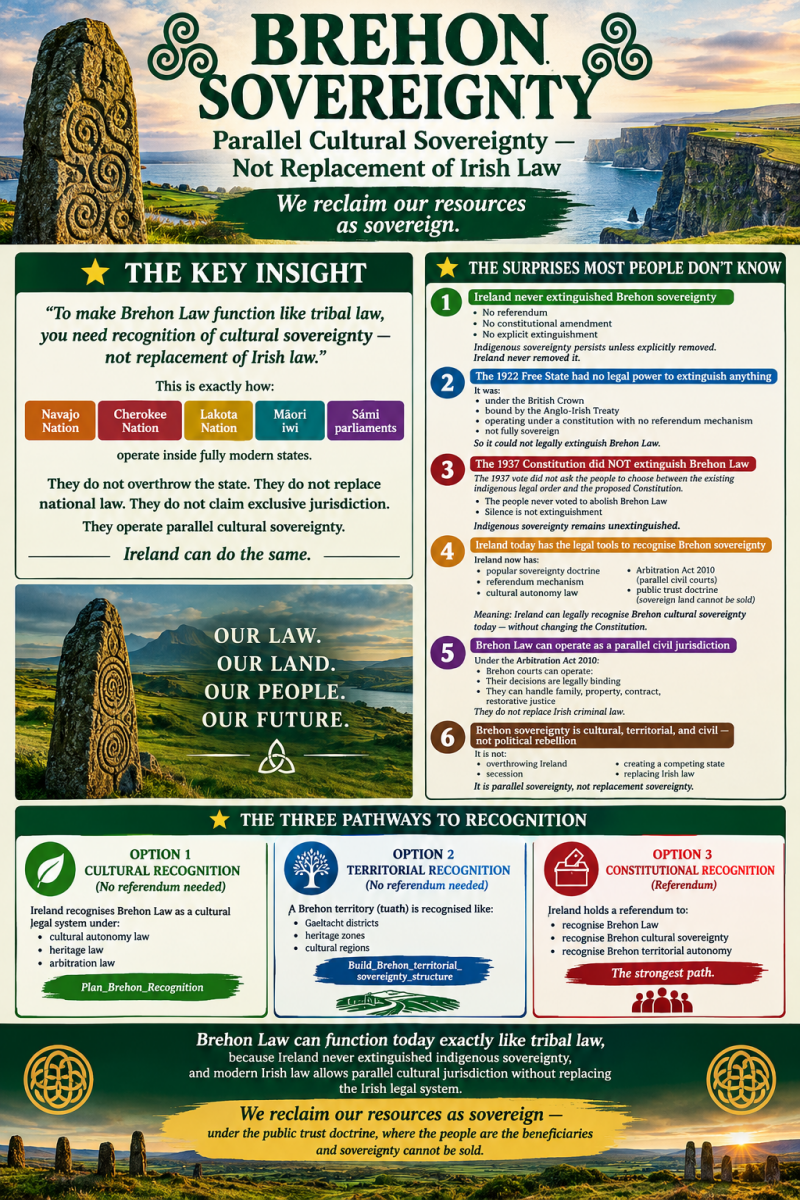
Our Proposal
We propose the establishment of an independent Commission on Brehon Law and Irish Legal Heritage.
The Commission would examine the historical, legal, constitutional and cultural questions surrounding Brehon Law and consider whether aspects of this heritage could contribute to modern Irish life.
Its work could include:
-
historical and legal research;
-
preservation and digitisation of manuscripts;
-
Irish-language legal scholarship;
-
public education;
-
archaeological and cultural heritage research;
-
Brehon-inspired voluntary mediation;
-
restorative-justice programmes;
-
voluntary arbitration operating within Irish law;
-
research into historical approaches to land and communal responsibility;
-
comparative research into customary and Indigenous legal traditions;
-
and consideration of whether further statutory or constitutional recognition could ever be appropriate.
The objective would not be to recreate medieval Ireland.
It would be to determine what can responsibly be carried forward from Ireland's indigenous legal heritage into a modern constitutional democracy.
The 1922 and 1937 Transitions
One area deserving particular attention is the transition from earlier legal systems to the constitutional arrangements established after independence.
The Constitution of the Irish Free State of 1922 contained provisions concerning the continuity and operation of law as well as provisions concerning State property and natural resources. Irish Statute Book
The 1937 Constitution subsequently established the constitutional structure under which the present State operates.
The Government's position expressed during the 2007 statute-revision process was that Brehon Law had already ceased to operate as a legal system and therefore was not carried into the constitutional arrangements of 1922 or 1937. Oireachtas
This proposal does not present an alternative interpretation as established law.
Instead, it proposes that the historical and constitutional question be examined comprehensively.
That examination should consider:
-
customary law;
-
legal continuity;
-
the distinction between written law and custom;
-
the historical suppression of Gaelic legal institutions;
-
constitutional jurisprudence;
-
cultural rights;
-
and the constitutional mechanisms through which new forms of recognition could potentially be created.
The Irish Language
A Brehon revival cannot be separated entirely from the Irish language.
The Gaelic legal tradition developed within an Irish-language intellectual culture.
The Constitution recognises Irish as the national and first official language. Irish Statute Book
A modern programme could therefore support:
-
Irish-language legal terminology;
-
Brehon legal scholarship;
-
bilingual publications;
-
university courses;
-
archival translation;
-
public education;
-
specialist legal research;
-
and the development of modern Irish-language legal resources.
Revitalising the legal heritage should mean revitalising knowledge, not merely reproducing historical terminology.
An Independent Commission
Commission on Brehon Law and Irish Legal Heritage
We propose the establishment of an independent Commission with expertise across multiple fields.
Its membership could include specialists in:
-
constitutional law;
-
legal history;
-
Brehon scholarship;
-
Irish language;
-
archaeology;
-
anthropology;
-
land law;
-
environmental law;
-
restorative justice;
-
human rights;
-
comparative customary and Indigenous law;
-
and community development.
The Commission should invite submissions from the public.
Its evidence should be published.
Its reports should clearly distinguish between:
Historical fact
Legal interpretation
Academic theory
Cultural aspiration
Proposed law
That distinction would be fundamental to the credibility of the project.
Recognition, Not Replacement
A modern nation can respect its constitutional present without erasing its legal past.
Brehon Law should not be treated merely as a romantic relic.
Nor should it be presented as an already-operational sovereign legal system.
It deserves something more serious:
scholarship, recognition, examination and a genuine national conversation.
Ireland already possesses constitutional and legal structures through which questions of cultural recognition, language, dispute resolution and constitutional change can be examined.
The Arbitration Act 2010 demonstrates that Irish law provides a framework in which consensual private arbitration can produce legally enforceable awards, subject to the legislation. Irish Statute Book
The Constitution recognises the sovereignty of the State, the role of the people, and the constitutional status of the Irish language. Irish Statute Book
These existing structures provide potential starting points for a modern programme of Brehon cultural revival.
The question is therefore worthy of serious examination:
Can Ireland revitalise its indigenous legal heritage while remaining fully democratic, constitutional and committed to modern human rights?
We believe Ireland should investigate that question openly.
Our Principle
Recognise the history.
Research the law.
Preserve the heritage.
Revive the language.
Explore lawful cultural autonomy.
Develop restorative and community-based institutions.
Protect Ireland's shared cultural and natural heritage.
And allow the people of Ireland to determine, through the constitutional process, any question that ultimately belongs to them.
Proposed Closing Declaration
Brehon Law is part of Ireland's legal heritage.
We do not seek to overthrow the constitutional State.
We seek recognition of the legal and cultural tradition that existed before it.
We ask Ireland to investigate that heritage honestly, preserve it carefully, and determine whether its principles can contribute to the Ireland of tomorrow.
Not replacement.
Recognition.
Not rebellion.
Cultural renewal.
Not the rejection of Irish law.
The recovery of Irish legal heritage within a modern constitutional Ireland.
Our heritage.
Our responsibility.
Our future.
Brehon Sovereignty
Recognising and Revitalising Ireland's Indigenous Legal Heritage
A proposal for cultural, legal and educational renewal within the constitutional State of Ireland
Ireland's legal heritage did not begin with the modern State.
For centuries, Gaelic Ireland developed its own legal traditions, institutions, professional legal scholars and systems of dispute resolution. Among the most important of these traditions is what is now commonly described as Brehon Law.
Brehon Law was not a modern statute book. It was predominantly a customary and learned legal tradition, transmitted through professional legal scholars and preserved in a substantial body of legal texts and commentary.
That legal tradition was progressively displaced by other systems of law.
The question for modern Ireland is therefore not whether medieval law can simply be declared the law of the Republic.
It cannot.
The question is whether a modern democratic Ireland can recognise, research, preserve and responsibly revitalise its indigenous legal heritage while remaining fully within the Constitution and the existing legal order.
We believe that question deserves serious national investigation.
The Displacement of Gaelic Law
The history of Irish law is also a history of legal displacement.
Following the Norman invasion and subsequent expansion of English authority, English legal institutions and written legislation increasingly operated alongside, and eventually displaced, Gaelic legal institutions.
The State's own 2007 parliamentary debates provide an important primary-source record of this historical question.
During the Statute Law Revision Bill debates, the Government stated that Brehon Law was predominantly an oral tradition rather than statute-based law and that it had been suppressed over a long period. The debate specifically referred to historical laws requiring English laws and customs to be observed in Ireland. Oireachtas+1
The Government's stated position was that by the end of the seventeenth century Brehon Law had been entirely suppressed and therefore did not survive into the legal systems established under the 1922 and 1937 constitutional arrangements. Oireachtas
That is an important historical and governmental statement.
But it should not prevent further scholarly inquiry.
The question can be examined without assuming the answer in advance.
The Historical Questions We Should Ask
A national investigation should examine:
-
What precisely constituted Brehon Law?
-
Which sources survive?
-
Which rules represented customary practice and which represent later legal commentary?
-
How did Gaelic legal institutions operate?
-
How and when were those institutions displaced?
-
Which historical laws were directed towards the suppression of Gaelic law and custom?
-
What aspects survived culturally after the disappearance of formal jurisdiction?
-
What happened to Gaelic concepts of landholding, obligation and community?
-
What principles remain culturally significant today?
-
Can any of those principles be translated into lawful modern institutions?
These questions belong to historians, lawyers, archaeologists, Irish-language scholars, anthropologists and the wider public.
They should be answered through evidence rather than assumption.
What This Proposal Does Not Claim
Clarity is essential.
This proposal does not claim that:
-
Brehon courts presently possess State judicial authority;
-
Brehon Law currently overrides Irish legislation;
-
the 1937 Constitution preserved an independent Brehon jurisdiction;
-
historical Brehon land principles automatically determine modern ownership;
-
the Arbitration Act 2010 creates sovereign Brehon courts;
-
Ireland has the same constitutional arrangements as States containing constitutionally recognised Indigenous nations;
-
or constitutional change can take place outside the procedures established by the Constitution.
Those propositions require evidence and legal analysis.
Our proposal is simpler:
Ireland should investigate the questions properly.
What Should the Commission Investigate?
Historical questions
-
What was Brehon Law?
-
What sources survive?
-
How did the system operate?
-
How and when was it displaced?
-
Which historical laws affected Gaelic law and custom?
Constitutional questions
-
What was the legal position during the transition to the Irish Free State?
-
What was the effect of the 1937 Constitution?
-
What status can customary law have under the present Constitution?
-
Could cultural recognition be established by ordinary legislation?
-
Would any proposed form of autonomy require constitutional amendment?
Institutional questions
-
Could Brehon-inspired mediation operate under existing law?
-
Could voluntary arbitration institutions be established?
-
What safeguards would be required?
-
What disputes could legally be referred to such institutions?
-
How would their decisions interact with the ordinary courts?
Cultural questions
-
How should Brehon heritage be taught?
-
What role should the Irish language play?
-
How should manuscripts and archaeological sites be protected?
-
How should local communities participate?
Resource questions
-
What does Brehon history reveal about land and communal responsibility?
-
How does this interact with Article 10?
-
Can historical ideas contribute to contemporary resource policy?
A National Conversation
This proposal is not an invitation to reject modern Ireland.
It is an invitation to understand Ireland more completely.
Before the modern State there were Irish legal traditions.
Before modern statutes there were customs.
Before modern courts there were professional legal scholars.
Before modern property law there were different understandings of land, obligation and community.
We cannot simply return to that world.
Nor should we pretend that it never existed.
We can study it.
We can preserve it.
We can teach it.
We can recover the Irish-language scholarship surrounding it.
And, where appropriate and lawful, we can develop modern institutions inspired by aspects of that heritage.
A Proposal for Ireland
This is a proposal for investigation, scholarship and democratic discussion.
It does not claim that the answers have already been decided.
It asks Ireland to investigate its own legal inheritance — carefully, openly and constitutionally — and to determine what, if anything, from that inheritance can responsibly contribute to the future.
Brehon sovereignty begins with knowledge.
The future begins with the people.